Losing a tooth can affect more than just your smile. A missing tooth may make chewing difficult, affect speech, and sometimes cause nearby teeth to shift. Fortunately, modern dentistry offers several tooth replacement options. Two commonly considered solutions are dental bridges and dental implants. Understanding the difference between these treatments can help you discuss the most suitable option with your dentist.
What Is a Dental Bridge?
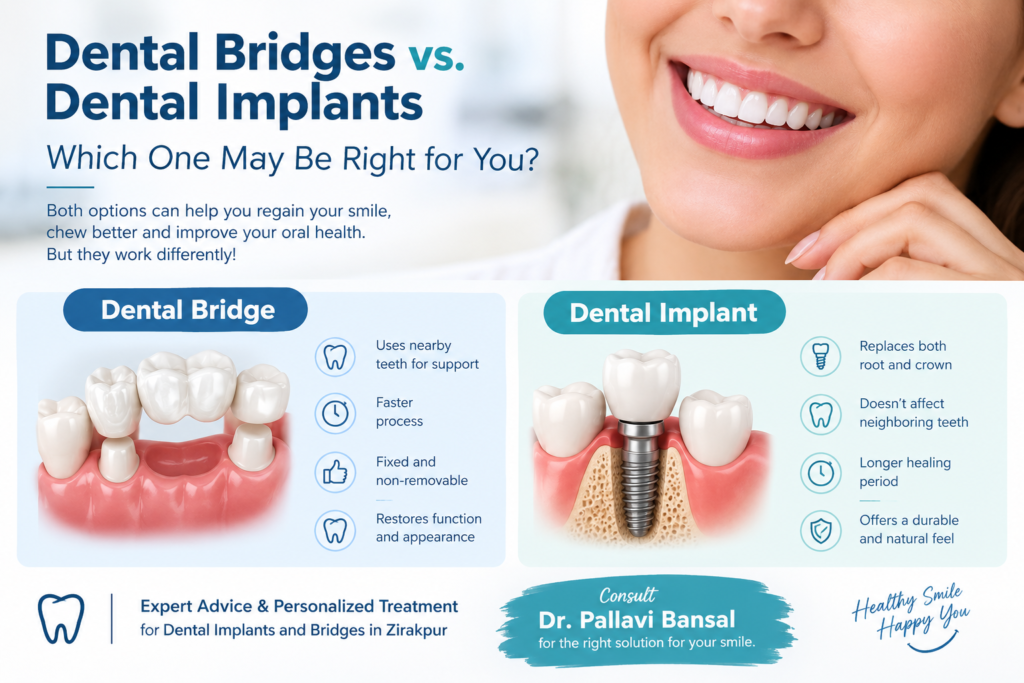
A dental bridge is a fixed dental restoration used to replace one or more missing teeth. It generally consists of an artificial tooth, called a pontic, supported by dental crowns attached to the neighboring teeth.
One of the benefits of a dental bridge is that it can restore the appearance and function of your smile without requiring an implant post in the jawbone. The treatment process can also be completed in fewer appointments in many cases.
However, a traditional bridge may require preparation of the supporting teeth. Your dentist will examine the condition of these teeth before recommending this option.
What Is a Dental Implant?
A dental implant is a tooth replacement option designed to replace both the missing tooth and its root. A small implant post is placed into the jawbone, and after the area has healed, a dental crown is attached to the implant.
Because implants are placed in the jawbone, they can provide a stable foundation for a replacement tooth. They also allow the replacement of an individual missing tooth without using neighboring healthy teeth as bridge supports.
The suitability of dental implants can depend on factors such as jawbone health, overall oral health, healing ability, and individual treatment requirements.
Dental Bridges vs. Dental Implants
Both treatments can restore a missing tooth, but they work differently. A dental bridge relies on neighboring teeth for support, while a dental implant is supported by an implant post placed in the jawbone.
A bridge may be considered when a patient wants a fixed tooth replacement without undergoing implant surgery or when the neighboring teeth are suitable for supporting a bridge. Dental implants may be considered when replacing an individual missing tooth while preserving the adjacent teeth is a priority.
The treatment timeline can also differ. Bridges may often be completed relatively quickly, while implants usually require a healing period before the final crown is placed.
Which Option May Be Right for You?
There is no single solution that is suitable for every patient. Your dentist will consider the number and location of missing teeth, the health of your gums and neighboring teeth, jawbone condition, overall oral health, and your treatment preferences.
A detailed dental examination is important before choosing between a bridge and an implant. Your dentist may also recommend dental X-rays or other imaging to evaluate the supporting structures.
For patients exploring Dental Implants and Bridges in Zirakpur, Dr. Pallavi Bansal can provide a professional evaluation and discuss available tooth replacement options according to individual dental needs.
Maintain Your Smile After Tooth Replacement
Whether you choose a bridge or implant, maintaining good oral hygiene is essential. Brush twice daily with fluoride toothpaste, clean between your teeth regularly, and visit your dentist for routine checkups. Proper care can help maintain your oral health and protect the surrounding teeth and gums.
Conclusion
Dental bridges and dental implants are both commonly used approaches for replacing missing teeth, but they differ in their structure, treatment process, and requirements. The right choice depends on your individual oral health and dental needs.
If you have a missing tooth and are considering Dental Implants and Bridges in Zirakpur, consult Dr. Pallavi Bansal for a dental evaluation and personalized treatment guidance.